These Alternative Energy Stocks Are Reshaping American Portfolios

Alternative energy stocks offer investors direct exposure to the renewable power transformation reshaping global electricity markets, from established utility-scale operators to solar manufacturers and wind farm developers. You’ll find three main categories on American exchanges: integrated utilities like NextEra Energy that operate both conventional and renewable assets, pure-play renewable companies such as Brookfield Renewable and Clearway Energy, and alternative energy ETFs that bundle these holdings into diversified funds. The sector spans multiple technologies (solar, wind, hydro, geothermal, and energy storage) and business models (project developers, equipment manufacturers, grid operators), each with distinct risk profiles and growth trajectories.
The investment case combines two powerful forces. First, the economics have shifted. Renewable generation now competes favorably with fossil fuels on cost alone in many markets, driving adoption beyond policy mandates. Second, growth projections from leading operators reflect this momentum: NextEra Energy projects 8% annual EPS growth through 2032, Brookfield Renewable expects to deliver over 10% annual FFO per share growth, and Clearway Energy aims for 7%-8% annual CAFD per share growth to 2030. These aren’t speculative targets but guidance from companies with operational projects and contracted revenue streams.
Choosing the right stocks requires understanding how each company generates returns, evaluating balance sheet strength to fund capital-intensive projects, and matching investment vehicles to your risk tolerance. Beginners often start with diversified ETFs to gain sector exposure, while experienced investors may select individual stocks based on technology preferences or geographic markets. We’ll explore evaluation frameworks, risk factors you can’t ignore, and how to integrate these positions into a broader portfolio strategy that balances growth potential with the sector’s inherent volatility.
Understanding the Alternative Energy Investment Landscape
Alternative energy stocks represent ownership in companies that generate, facilitate, or support electricity and fuel production from renewable resources. Unlike traditional energy sector stocks, which focus on oil, gas, coal extraction, refining, and fossil fuel infrastructure, alternative energy investments center on technologies and business models designed to produce power with minimal environmental impact and unlimited fuel sources.
The renewable energy investment universe spans several distinct technology platforms. Renewable sources include wind, solar hydroelectric, geothermal, and biomass energy production. Solar companies harness sunlight through photovoltaic panels or concentrated thermal systems. Wind operators develop and manage turbine installations both onshore and offshore. Hydroelectric firms leverage water flow through dams and run-of-river systems, while geothermal companies tap underground heat reservoirs for consistent baseload power generation.
Beyond power generation itself, the sector includes equipment manufacturers who build the turbines, panels, inverters, and battery storage systems that make renewable energy viable. Renewable infrastructure companies own and operate portfolios of clean energy assets, often structured to provide steady cash flows through long-term power purchase agreements. Many traditional utilities have also built substantial renewable portfolios alongside their legacy generation assets, creating hybrid investment profiles.
- Alternative Energy
- Power generated from renewable resources like wind, solar, hydro, and geothermal rather than finite fossil fuels. These companies derive revenue primarily from clean energy production and technologies.
- Traditional Energy Sector
- Companies focused on oil and gas production, refining, pipeline operations, and fossil fuel infrastructure. This sector historically dominates the Energy classification on American exchanges.
- Renewable Infrastructure
- Physical assets such as wind farms, solar installations, and transmission systems that generate or transport clean energy. Infrastructure companies typically operate under long-term contracts providing predictable revenue.
What fundamentally distinguishes alternative energy stocks from their traditional counterparts is the revenue model itself. Traditional energy companies profit from extracting and selling finite commodities subject to volatile global pricing. Alternative energy businesses, in contrast, generate income from converting free natural resources into electricity, often locked in through fixed-price contracts spanning decades. This structural difference creates distinct risk profiles, growth trajectories, and valuation frameworks that investors must understand when building energy sector exposure.
Types of Alternative Energy Stocks Available on American Exchanges

Direct Renewable Energy Producers
Direct renewable energy producers operate power generation facilities that convert natural resources into electricity. These companies own and manage assets like solar farms, wind installations, and hydroelectric plants, selling the power generated to utilities, corporations, or directly into wholesale energy markets.
Their revenue typically comes through long-term contracts called power purchase agreements (PPAs), which provide predictable cash flows by locking in electricity prices for 10 to 25 years. Some companies also earn capacity payments for maintaining grid reliability and renewable energy credits that utilities purchase to meet clean energy requirements. This contract-heavy business model offers more stability than traditional power generation exposed to volatile commodity prices.
The largest publicly traded renewable producers include NextEra Energy, which projects 8% annual earnings growth through 2032, and Brookfield Renewable, expecting over 10% annual growth in funds from operations per share while boosting its dividend 5%-9% yearly. Clearway Energy targets 7%-8% annual growth in cash available for distribution through 2030. These companies balance mature, cash-generating assets with new project development to sustain growth while funding dividends that appeal to income-focused investors.

Equipment Manufacturers and Technology Providers
Equipment manufacturers and technology providers form the industrial backbone of the renewable energy transition. These companies design and produce the physical components that make clean energy possible, solar panels, wind turbines, inverters, battery storage systems, and the specialized materials required for renewable infrastructure.
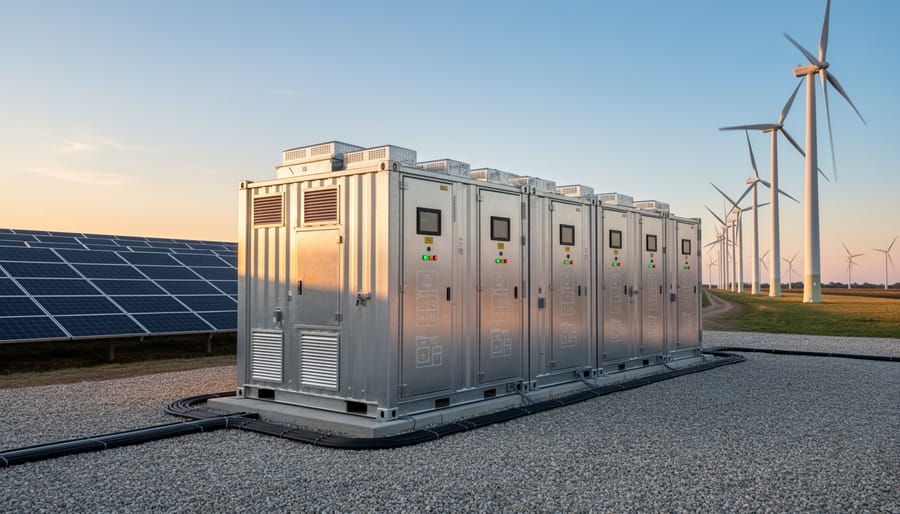
The sector includes both established industrial giants that have pivoted toward renewable technology and specialized manufacturers focused exclusively on clean energy equipment. Solar panel manufacturers range from large-scale producers to companies developing next-generation photovoltaic technology. Wind turbine makers typically operate at massive scale, given the engineering complexity and capital requirements of modern turbines. Battery and energy storage companies have seen particularly strong investor interest as grid-scale storage becomes essential for managing intermittent renewable generation.
These stocks often demonstrate different financial characteristics than power producers. Revenue can be more volatile, tied to project cycles and manufacturing capacity utilization. However, companies with strong technology advantages, efficient production, or dominant market positions can deliver substantial growth as renewable installations expand. Many equipment manufacturers also benefit from diversified revenue streams across multiple renewable technologies and global markets, reducing exposure to any single regulatory environment or technology risk.
Renewable Infrastructure and Utilities
Renewable infrastructure and utilities represent the more established corner of the alternative energy landscape. These companies typically have decades of operational history, stable cash flows, and the financial strength to fund large-scale renewable projects. Unlike pure-play startups, they offer immediate diversification and often pay dividends while transitioning their portfolios toward clean energy.
Major utilities with significant renewable assets combine traditional operations with growing wind, solar, and battery storage portfolios. They benefit from existing customer bases, transmission infrastructure, and regulatory relationships that newer entrants lack. NextEra Energy, for instance, projects 8% annual EPS growth through 2032 as it expands renewable capacity. These companies can absorb the upfront costs of billion-dollar wind farms or solar installations while maintaining steady returns from their broader operations.
Infrastructure companies focus on owning and operating clean energy assets rather than generating power for end consumers. Brookfield Renewable expects to deliver over 10% annual FFO per share growth while planning dividend increases of 5%-9% annually. Clearway Energy targets 7%-8% annual CAFD per share growth to 2030. These firms acquire renewable facilities, manage them efficiently, and distribute most cash flow to shareholders. They offer exposure to renewable growth without the technology risk or customer acquisition challenges that manufacturers and producers face.
This category suits investors seeking both income and participation in the energy transition. The trade-off: slower growth than emerging players, but with proven business models and tangible assets backing each share.
Alternative Energy ETFs: Diversified Exposure Made Simple
Alternative energy ETFs offer a straightforward way to invest in the renewable sector without researching individual companies. These funds pool investor money to buy shares in dozens of alternative energy businesses, from solar panel manufacturers to wind farm operators, giving you instant exposure to the entire sector through a single ticker.
The mechanics are simple. When you buy shares of an alternative energy ETF, you’re purchasing a proportional stake in all the companies the fund holds. The ETF manager handles the selection, weighting, and rebalancing. Your returns track the collective performance of the portfolio, minus a small annual fee. This passive approach eliminates the need to monitor quarterly earnings from multiple companies or worry about a single firm’s project delays tanking your investment.
ETFs shine for investors who want renewable energy exposure but lack the time or confidence to pick individual winners. They’re also useful for portfolio diversification, adding clean energy without overweighting any one company or technology. The trade-off is that you won’t capture the full upside if one stock skyrockets, but you’re equally protected from a single holding collapsing.
When evaluating these funds, check the expense ratio first, annual fees typically range from 0.20% to 0.70%, and lower is better for long-term holding. Review the holdings list to understand what you’re actually buying: some ETFs focus on pure-play renewable producers, while others include utilities with mixed energy portfolios or equipment makers. Look at the fund’s asset size and average trading volume; larger, more liquid ETFs generally offer tighter bid-ask spreads, reducing your trading costs.
Consider the fund’s weighting methodology, too. Market-cap weighted ETFs concentrate holdings in the biggest companies, while equal-weighted funds spread investment more evenly across all constituents, potentially offering better exposure to smaller, high-growth names.
Growth Potential and What Drives Alternative Energy Stocks
Growth potential in alternative energy stocks stems from several converging forces that are fundamentally reshaping how America generates and consumes power. Understanding these drivers helps you assess whether individual companies or funds align with broader market momentum.
Policy support remains a cornerstone catalyst. Federal incentives like tax credits drive clean energy project development by improving returns on capital for developers and making renewable installations more economically attractive. State-level renewable portfolio standards and utility-scale procurement mandates create sustained demand for clean power, giving companies with strong project pipelines predictable revenue streams. When evaluating stocks, consider how dependent a company is on specific policies versus fundamental cost competitiveness.
Technology improvements continue to lower production costs while boosting efficiency. Solar panel costs have declined substantially over the past decade, and wind turbine capacity factors have improved through taller towers and advanced blade designs. These gains translate directly to better unit economics for producers and equipment manufacturers. Companies investing in next-generation technologies like floating offshore wind or advanced battery storage may offer higher growth potential but carry execution risk.
Cost competitiveness has reached a tipping point in many markets. Renewable energy frequently undercuts fossil fuels on a levelized cost basis, even without subsidies, making projects viable based on economics alone. This shift expands the addressable market beyond environmentally motivated buyers to every utility and corporate customer seeking the lowest-cost power.
Corporate sustainability commitments add another demand layer. Major corporations have pledged to source renewable electricity for operations, creating long-term offtake agreements that provide revenue visibility for producers. Companies with established relationships and proven ability to deliver large-scale projects benefit most.
The fundamental backdrop translates to tangible growth projections. NextEra Energy projects 8% annual EPS growth through 2032, while Brookfield Renewable expects to deliver over 10% annual FFO per share growth, figures that reflect industry-wide tailwinds rather than isolated company performance. These drivers work together, creating multiple paths to value creation across the alternative energy landscape.
Evaluating Alternative Energy Stocks: Key Metrics That Matter
Financial Health Indicators
When evaluating alternative energy stocks, focusing on the right financial metrics helps you separate companies with genuine growth potential from those living on hype alone. Unlike traditional energy companies where oil price correlation dominates, renewable energy investors need to track metrics that reflect long-term contracted revenues and operational expansion.
Earnings per share (EPS) growth remains relevant for vertically-integrated utilities with renewable portfolios. NextEra Energy, for instance, projects 8% annual EPS growth through 2032, demonstrating how established players can deliver steady appreciation while maintaining dividend payouts.
For companies structured as yieldcos or master limited partnerships, funds from operations (FFO) and cash available for distribution (CAFD) matter more than traditional earnings. These metrics strip out non-cash charges and show actual cash generation capacity, critical when assessing dividend sustainability. Brookfield Renewable expects to deliver over 10% annual FFO per share growth, supported by its development pipeline and acquisition strategy.
Dividend growth potential deserves particular attention in alternative energy, where many companies use distributions to attract income-focused investors while reinvesting for expansion. Here’s how some leading companies frame their growth targets:
| Company | Key Metric | Projected Growth |
|---|---|---|
| NextEra Energy | EPS | 8% annually through 2032 |
| Brookfield Renewable | FFO per share | Over 10% annually |
| Brookfield Renewable | Dividend | 5%-9% annually |
| Clearway Energy | CAFD per share | 7%-8% annually to 2030 |
These forward-looking projections give you benchmarks, but verify them against actual quarterly results. Companies that consistently meet or exceed their guidance build credibility; those that repeatedly fall short warrant skepticism regardless of how compelling their sector story sounds.
Operational and Strategic Considerations
Beyond the financial statements, successful alternative energy companies distinguish themselves through operational excellence and strategic positioning. When evaluating potential investments, look at the company’s development pipeline, a robust queue of shovel-ready projects signals growth capacity and management confidence. Companies that disclose their project pipeline in gigawatts or megawatts under development give you visibility into future revenue potential.
Geographic diversity matters more in renewable energy than in traditional sectors. A company with assets spread across multiple states or regions reduces exposure to localized weather patterns, state-level policy shifts, and grid constraints. Similarly, technology mix provides natural hedging, firms that balance solar, wind, and storage assets can optimize production regardless of seasonal or regional variations.
The regulatory landscape deserves close attention. State renewable portfolio standards create predictable demand, while federal production tax credits directly impact project economics. Companies that actively work with regulators and maintain strong relationships with local communities tend to secure permits faster and face fewer development delays.
Management track record reveals how well a team executes. Have they consistently brought projects online on time and within budget? Do they demonstrate disciplined capital allocation, or do they chase growth at the expense of returns? Look for leadership teams with deep operational experience in energy infrastructure, not just financial engineering backgrounds. Their ability to navigate construction challenges, manage contractor relationships, and optimize asset performance ultimately drives long-term shareholder value.
Risk Factors to Consider Before Investing
Alternative energy stocks offer significant growth potential, but they carry distinct risks that every investor should understand before allocating capital. Policy dependency tops the list. Government incentives, tax credits, and renewable energy mandates have historically driven much of this sector’s expansion. When these supports shift, due to elections, budget constraints, or changing political priorities, stock prices can swing sharply. Companies relying heavily on subsidies face particular vulnerability if favorable policies expire or get scaled back.
Technology disruption cuts both ways in this sector. While innovation drives growth, it also creates obsolescence risk. A solar company invested in current panel technology might struggle if a competitor commercializes dramatically more efficient alternatives. Battery storage breakthroughs could upend assumptions about which renewable sources dominate. The pace of change means today’s industry leader could become tomorrow’s laggard without continuous R&D investment and adaptation.
Commodity price exposure creates another layer of volatility. Many renewable energy projects depend on materials like lithium, copper, cobalt, and rare earth elements. Price spikes in these inputs squeeze margins and delay projects. Conversely, falling natural gas prices can reduce renewable energy’s competitive advantage in certain markets, affecting growth trajectories.
Market volatility hits alternative energy stocks harder than many sectors. These companies often trade at premium valuations based on future growth expectations rather than current earnings. When broader markets correct or interest rates rise, growth-focused stocks typically experience steeper declines. The sector saw this dynamic play out during various market cycles, with drawdowns exceeding those of established energy companies.
Competition intensity continues rising as more players enter profitable renewable niches, compressing margins and making differentiation harder. Investors should weigh these risks against the sector’s opportunities and size positions accordingly within a diversified portfolio.
Building Your Alternative Energy Portfolio Strategy
Starting with alternative energy requires matching your approach to your experience and goals. A beginner might open a position with a single broad-based alternative energy ETF, capturing exposure to dozens of companies across solar, wind, and renewable infrastructure without needing to analyze individual balance sheets. This provides instant diversification and reduces the risk of picking a company that stumbles on a project delay or regulatory issue.
As comfort grows, you can layer in targeted positions. An investor with moderate experience might allocate 60% to an ETF for core exposure, then dedicate 40% to two or three individual stocks chosen for specific strengths, perhaps a utility with verified growth like NextEra Energy’s projected 8% annual EPS expansion through 2032, paired with an infrastructure play like Brookfield Renewable targeting over 10% annual FFO per share growth. This blended approach balances stability with upside potential.
Experienced traders comfortable with volatility might tilt toward growth-oriented equipment manufacturers or emerging technology providers, accepting higher price swings in exchange for outsized returns if adoption accelerates. Even here, discipline matters: limit any single position to 5-8% of your portfolio to contain damage if a company faces unexpected headwinds.
Time horizon shapes everything. If you’re investing for retirement decades away, short-term price fluctuations become noise against the sector’s long-term trajectory. A three-to-five-year view allows you to ride out policy cycles and benefit from companies like Clearway Energy, which aims for 7%-8% annual CAFD per share growth to 2030 while increasing dividends. Shorter timelines demand more conservative allocations and tighter stop-losses.
Rebalance periodically. When one holding surges and dominates your alternative energy sleeve, trim it back to your target weight and redirect proceeds into lagging positions or new opportunities. Set calendar reminders to review earnings reports, management guidance updates, and shifts in federal or state energy policy that could alter the investment thesis. Treat this as an evolving portfolio component, not a set-and-forget trade.
The landscape for alternative energy investing on American exchanges continues to expand as renewable infrastructure becomes a more established part of the energy mix. Companies like NextEra Energy, projecting 8% annual earnings growth through 2032, and Brookfield Renewable, expecting over 10% annual FFO per share growth with dividend increases of 5%-9% yearly, demonstrate that this sector offers concrete opportunities backed by real operational performance. Clearway Energy’s targeted 7%-8% annual CAFD per share growth to 2030 further illustrates the sector’s growth trajectory. These aren’t speculative promises but forward-looking plans from companies with established track records.
Whether you choose individual stocks, ETFs for diversified exposure, or a combination approach, the key is staying informed and adaptable. Markets evolve, technologies improve, and policy landscapes shift. That’s precisely why ongoing education and community discussion matter. The Dforce Solar platform offers a space where investors at all experience levels share insights, discuss market developments, and learn from each other’s experiences. Join the conversation to exchange perspectives on emerging opportunities, ask questions about evaluation metrics, and stay current on trends shaping the renewable energy investment space. Your participation helps build a more informed investing community while deepening your own understanding of this dynamic sector.